STRATEGIC DESIGN · GROWTH & SCALE
Rooms & Ideas
Creating IKEA’s Global Inspiration & Product Discovery Platform
Created for IKEA
01 — EXECUTIVE SUMMARY
The Strategic Mandate
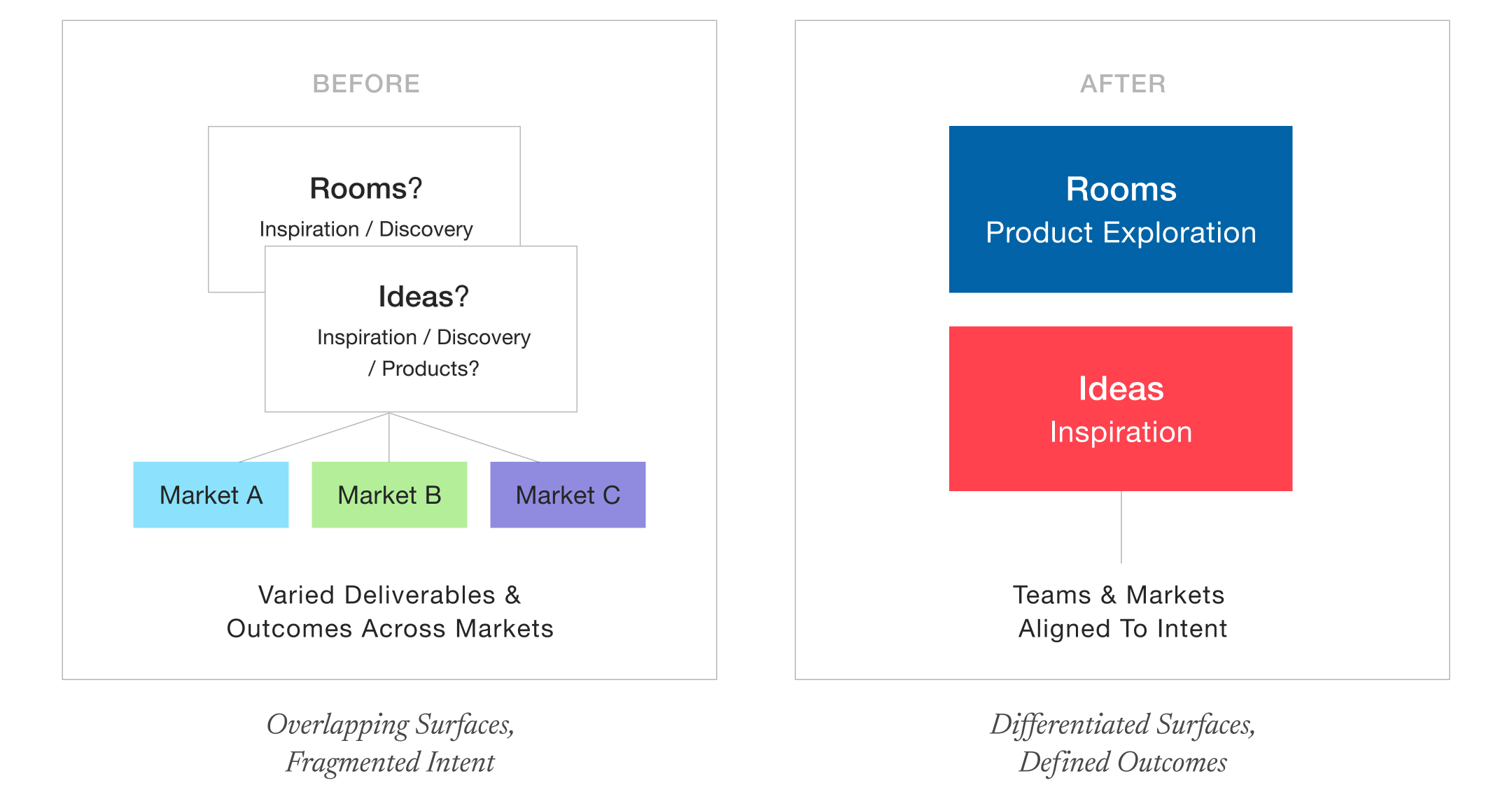
In 2023, I took end-to-end strategic ownership of a two-year initiative to overhaul how IKEA manages Inspiration and Product Discovery across 30+ markets. Two core legacy web experiences known as "Rooms" and "Ideas", lacked clear differentiation in customer intent, content and success metrics, leaving teams misaligned and customers confused between surfaces that served neither discovery nor inspiration very well. Through deep investigation, research and strategic framework definition, I redefined both: "Rooms" would become the primary space for product exploration and commercial outcomes whereas "Ideas" would showcase broad inspiration and knowledge discovery. The global foundations were built across a well defined content strategy, SEO, data foundations and shared tagging that both experiences now built on were the result of a deliberate and structured approach to strategy and execution.
02 — MY ROLE
Program Orchestration & Strategic Ownership
Managing a multi-year initiative of this magnitude required a great deal of orchestration. In an ecosystem serving millions of annual visits, I helped bridge the gap between abstract strategy and technical engineering to ensure the core vision survives the pressures of a 30-market rollout. As the program orchestrator, I maintained end-to-end ownership of the vision and its structural integrity. My role was to be accountable for the synthesis of five critical pillars of ownership:
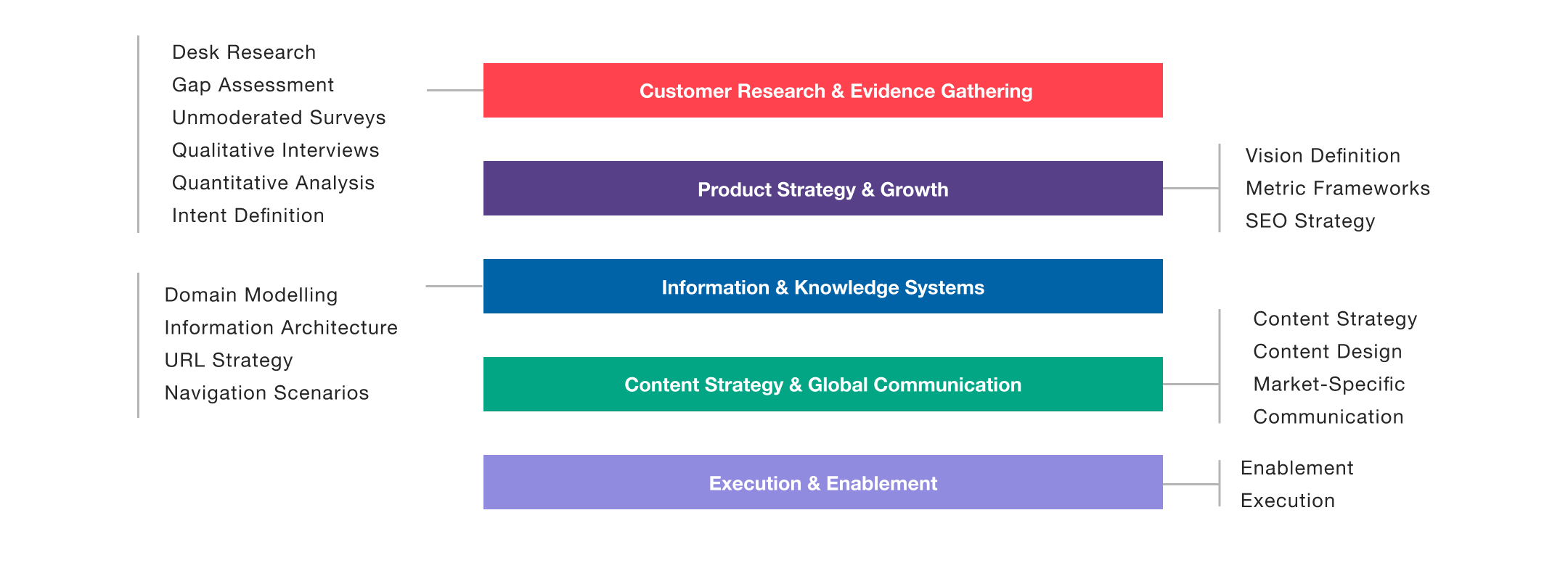
Customer Research & Evidence: Grounding every architectural decision in validated data.
Product Strategy & Growth: Defining the roadmap and commercial objectives to drive global scale.
Information & Knowledge Systems: Building the data structures that ground the experience.
Content Strategy & Glocal Communication: Establishing the framework for global consistency and local nuance.
Execution & Enablement: Facilitating the transition from concept to a high-priority global initiative. By holding the end-to-end vision across these specialist disciplines, I ensured that misalignments were resolved before they impacted the customer. This framework provided the necessary stability to initiate the first phase of the project: Customer Research.
03 — CUSTOMER RESEARCH
Clarifying Intent through Evidence
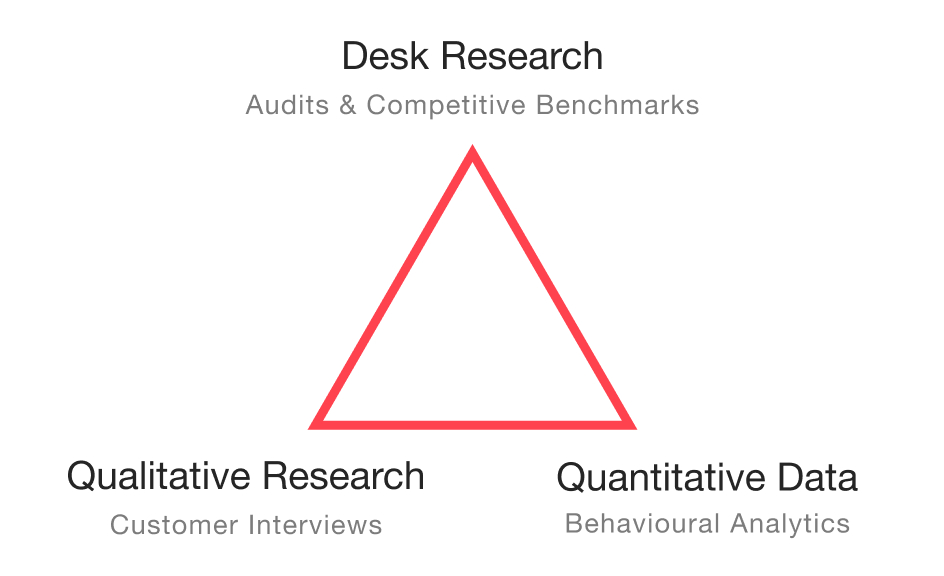
The program began by addressing a primary source of friction: the overlapping purposes of "Rooms" and "Ideas." These two high-visibility spaces frequently hosted valuable content but lacked clear differentiation, leading to user confusion and diluted commercial impact. Without global guidance, individual markets were independently interpreting "inspiration," resulting in a confusing experience where globally supplied content was used inconsistently. To resolve this, I implemented a triangulated research approach to understand and define what should be globally consistent versus market-adaptable:
DESK RESEARCH & GAP ASSESSMENT
I thoroughly analyzed each market-specific implementation and every section under "Rooms" and "Ideas" to identify the patterns of divergence from global intent (or a lack thereof). I also benchmarked global competitors to understand industry-standard inspiration and commercial models.
QUALITATIVE RESEARCH
I partnered with our UX Research team to set up customer interviews to understand what type of home decor topics customers are interested in, how customers expect these to be presented on the IKEA website and how they experience the content currently live on the "Rooms" and "Ideas" sections. There were live moderated invervews with customers across markets. While I helped set the scope, direct the research, attended all interviews and helped sythesise the results, this aspect was led by Juulia Enqvist (UX Research Lead).
QUANTITATIVE DATA SYNTHESIS
I partnered with the SEO and Data Analytics teams to synthesize legacy unmoderated surveys on inspiration consumption and get support to build new dashboards to analyse our present performance to use these data points to triangulate with our desk research and qualitative reseach to get a 360° view of our present performance.
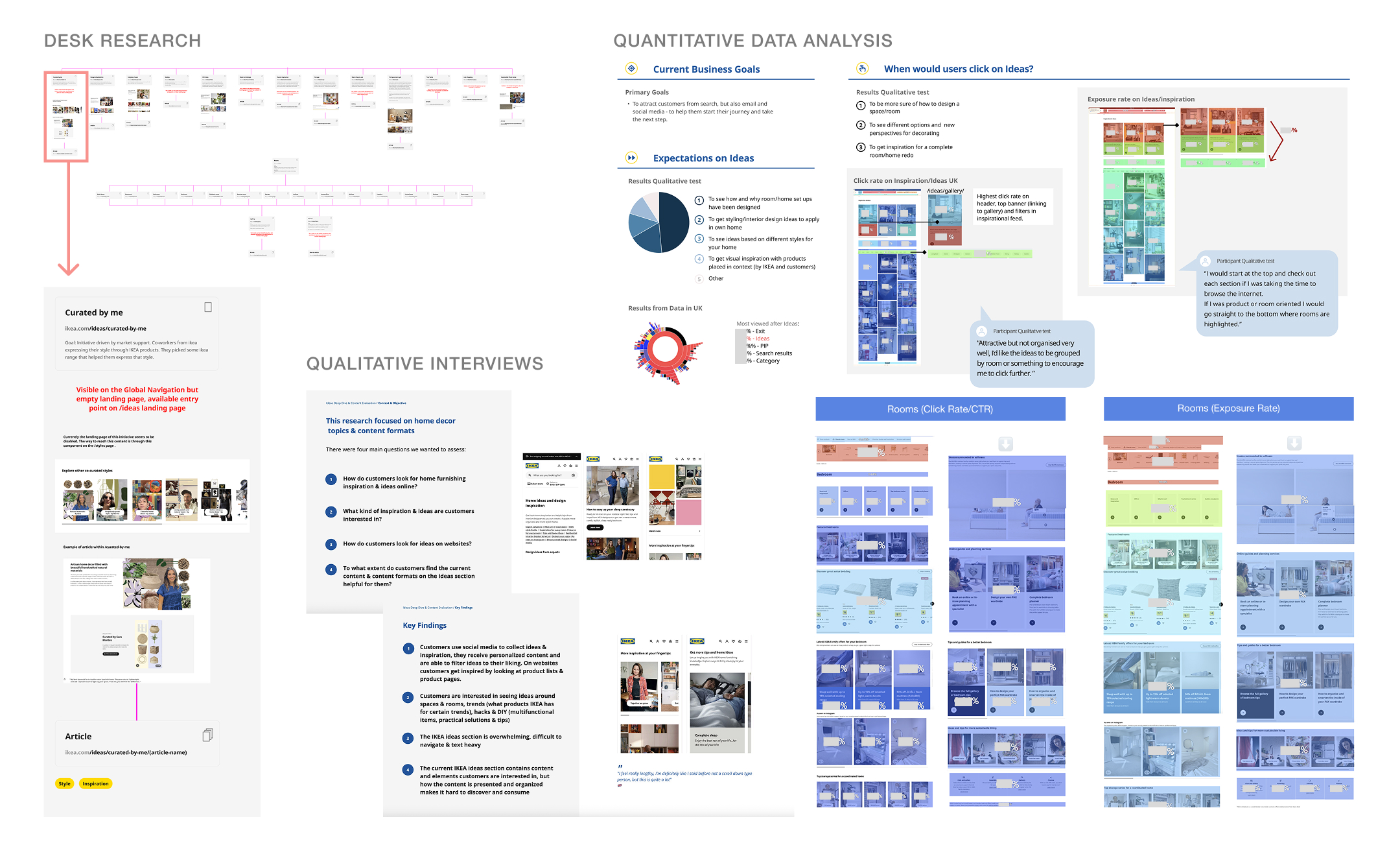
I synthesised all this data and research with the relevant teams to validate how frequently users performed specific actions, how they viewed and consumed the Rooms & Ideas spaces, what kind of expectations they had and where we fell back and found opportunity areas. This resulted in creating an 'Intent Framework' that became the program’s foundation. By defining clear user outcomes for each space through these results, we moved from subjective interpretations to data-driven product decisions.
04 — PRODUCT STRATEGY & GROWTH
Aligning Vision with Metrics
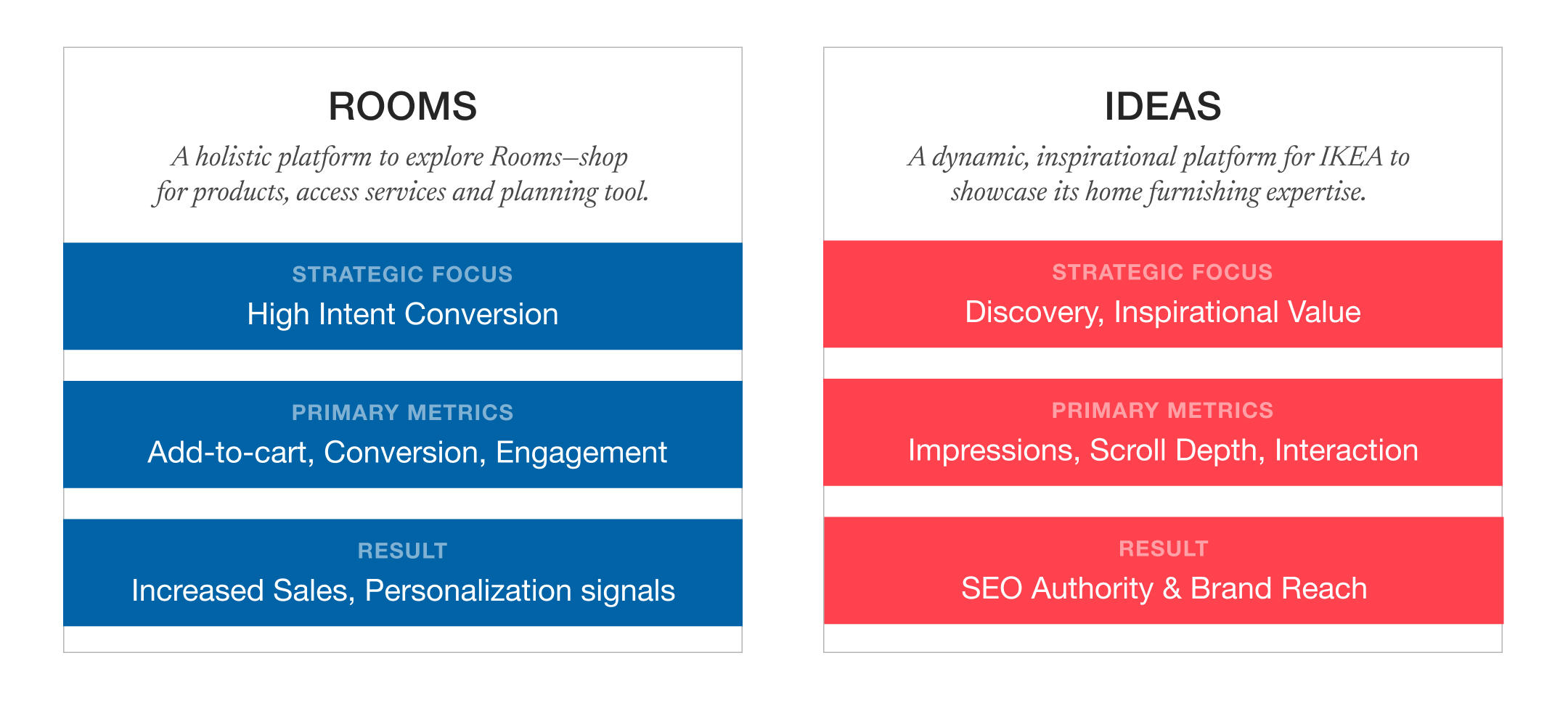
To optimize an ecosystem of this scale, my strategy focused on the separating "Inspiration & Discovery" (Ideas) from "Product Exploration" (Rooms). This ensured that users could find what they needed, whether it was broad inspiration or specific product solutions, without friction. I implemented a metric framework to separate the success of inspiration from the mechanics of conversion. This allowed teams to optimize each experience against its true purpose rather than chasing diluted KPIs and also helped place relevant content to the right page.
In parallel, I directed an SEO strategy layer to analyze high-intent commercial and inspirational keywords. By routing search traffic based on this intent, we ensured users landed on the experience that best aligned with their needs, improving both initial discoverability and downstream commercial performance. This blueprint served as the requirement for the underlying technical architecture as well.
05 — FOUNDATIONAL MODELS
Information & Knowledge Systems
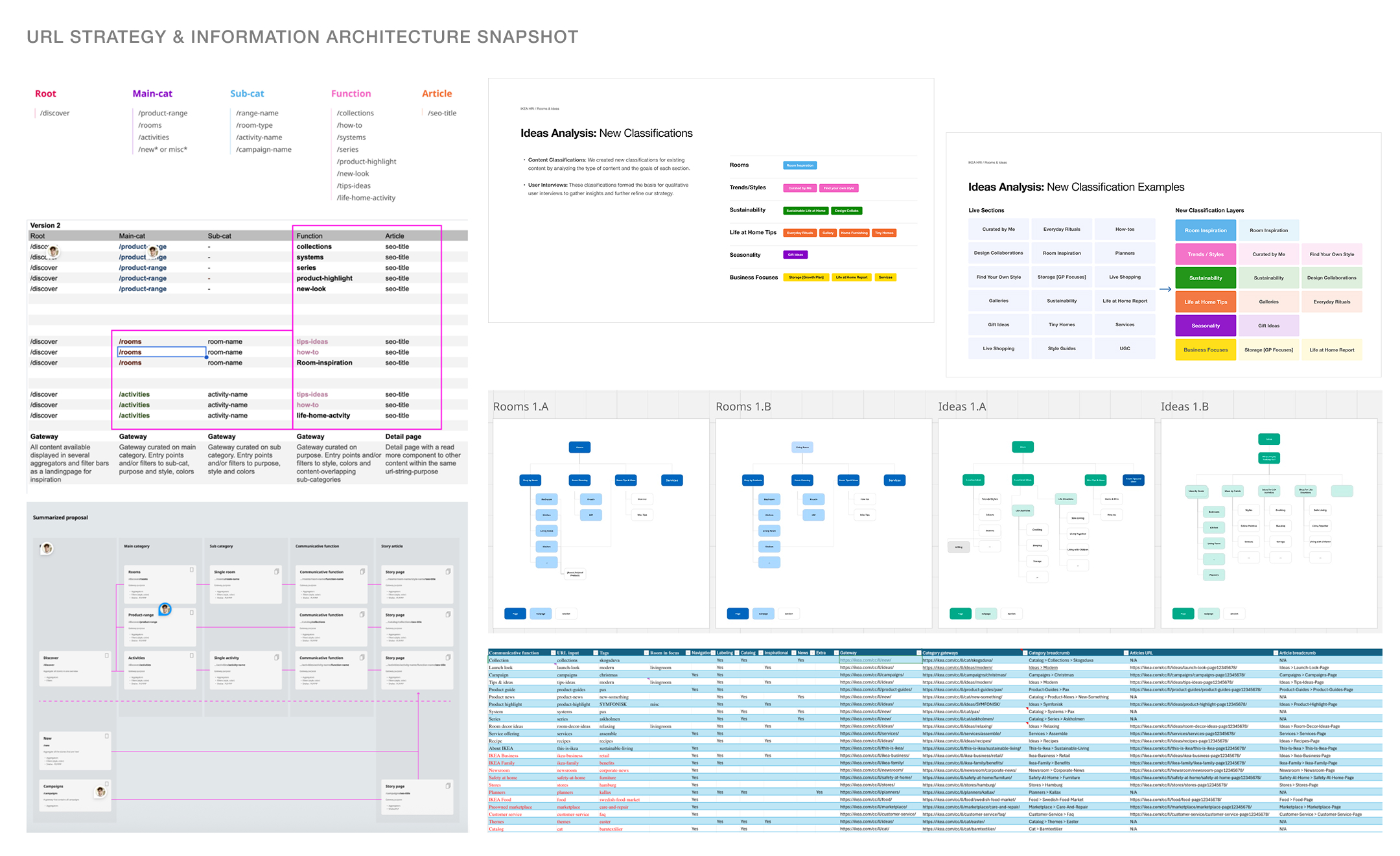
As IKEA underwent a major platform transition, a strategic opportunity emerged to move from a broad vision to a systemic foundation. The goal was to transform content from static assets into dynamic data signals capable of supporting long-term ambitions, enhancing our URL strategy increase SEO relevance and support our (parallel) personalization efforts. This vision was distilled into core architectural decisions:
- Domain Modelling: Defining the technical boundaries for "Rooms" and "Ideas".
- Shared Taxonomy: Implementing tagging and classification systems to capture customer preference signals.
- Global Principles: Establishing information architecture principles that balanced global consistency with local flexibility. These decisions directly informed the URL strategy and navigation scenarios based on user intent. By structuring information this way, we enabled the system to use customer interactions in "Rooms" and "Ideas" as signals to understand preferences and tailor content over time. This architectural framework transformed the customer-facing content layer into a scalable data engine.
06 — CONTENT STRATEGY
Balancing Global Guardrails with Local Relevance
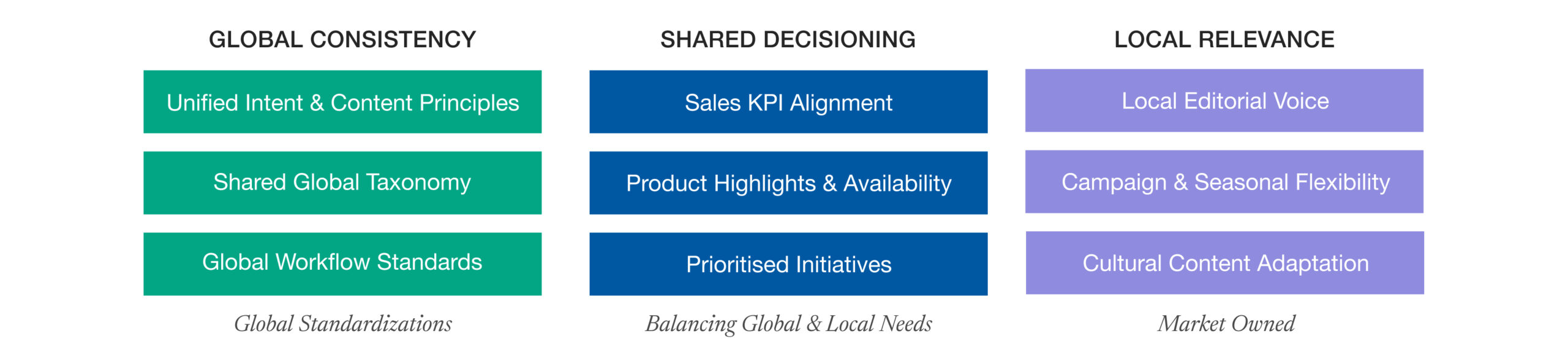
A recurring challenge was balancing brand consistency with the cultural nuances and KPIs of 30+ markets. This was approached through a two-way workshop between global management and market communication teams, aligning global learnings with on-the-ground realities. The outcome was a shared framework: unified content principles, intent and tone guidelines, and clear alignment with global sales KPIs, while deliberately leaving room for local flexibility. Markets weren't handed rigid constraints, they were given structured recommendations that let them optimise for local context and user behaviour. The result was an experience that felt like IKEA to a user anywhere in the world, while remaining meaningful to them where they were.
07 — STAKEHOLDER MANAGEMENT
Navigating Complexity & Buy-Ins
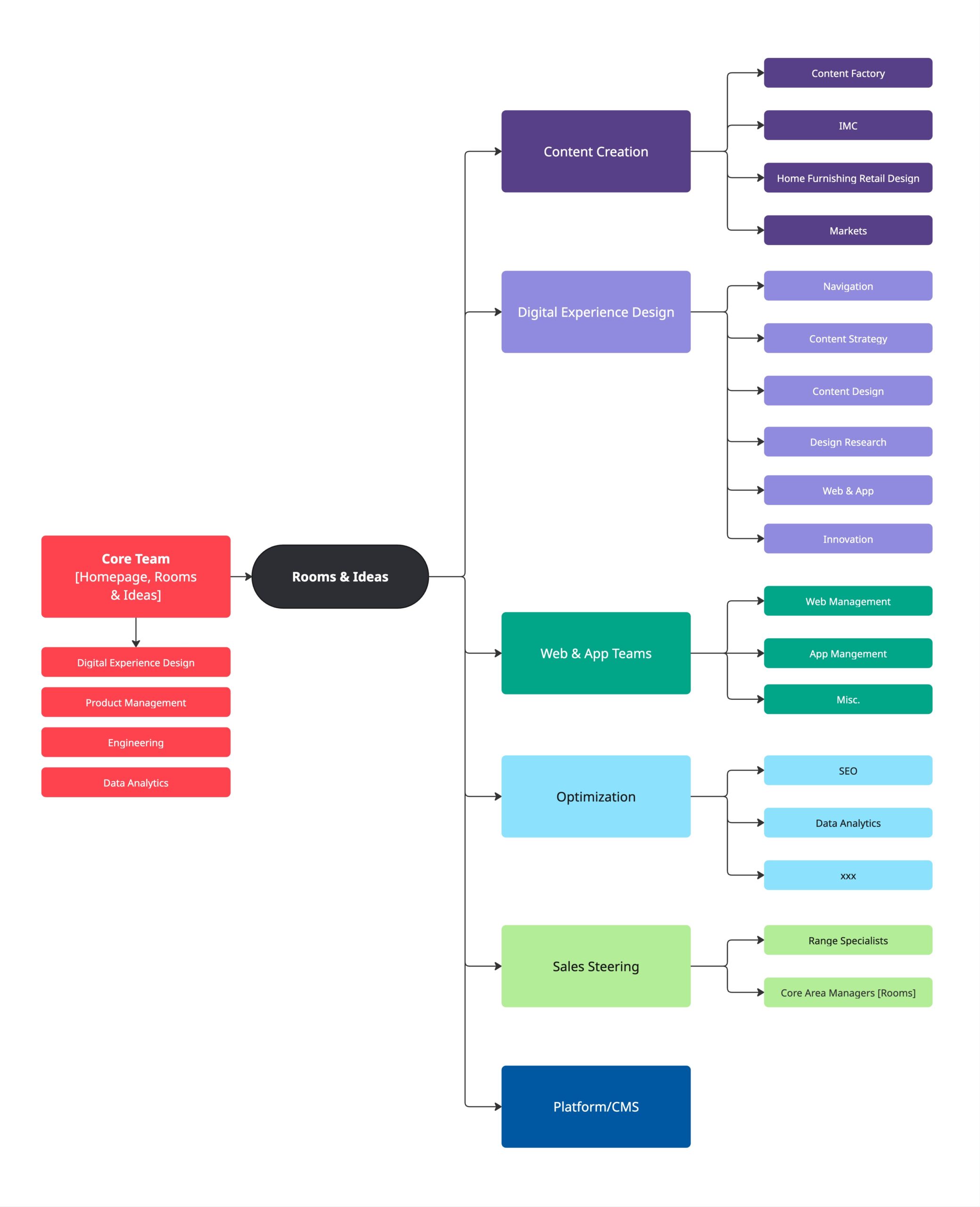
One of the biggest challenges of solving the Rooms and Ideas spaces was stakeholder alignment. The work touched six distinct stakeholder groups: Content Creation, Digital Experience Design, Web & App, Optimization, Sales Steering, and Platform/CMS.
Each group brought its own definition of success, a deep investment in how these pages performed commercially and how customers interacted with them. They had their own rhythms and their own idea of what these two surfaces were for. The core team (where I belonged) sat at the intersection of Digital Experience Design, Product Management, Engineering and Data Analytics and had to hold all of this together: translating a strategic intent into decisions that were coherent across functions, without losing the nuance that made the separation meaningful in the first place.
Acquiring buy-in at this scale meant many rounds of presentations, co-working sessions and difficult conversations. It often required balancing competing needs, making tradeoffs and at times, making calls that not everyone agreed with. The separation only became possible once there was enough shared understanding of why it needed to happen at all.
08 — DELIVERY
Execution & Enablement
This two-year program transformed IKEA’s discovery landscape from a fragmented collection of pages into an intent-led model. To do this, the execution roadmap was anchored in three leadership actions: securing commitment through evidence-based feasibility studies; resolving tension between global scale and market performance; and enabling cross-functional teams to move with confidence through clear ownerships.

09 — SUMMARY
Executive Takeaways
These are my executive takeaways from two years leading this effort:
- Alignment at Scale: Structured decision-making that balanced global scale with market autonomy.
- Intent-Led Ecosystem: Pre-defined intent preceded structure, metrics and content. Rooms would drive conversion, Ideas drive discovery and structural misalignment would be removed.
- Differentiated Metrics: Rooms would be tracked based on metrics like add-to-cart (ATC) and conversion. Ideas would be measured against impressions and scroll depth. Each surface had its own well defined key performance indicator (KPI).
- Data Foundations: SEO and Information Architecture would act as intent signals that allowed for scalable content delivery & helped lay stroung foundations for personalization.
- Global / Local Relevance: Shared tagging, domain models and URL structures would be consistent across 30+ markets, with contect flexible for cultural adaptation and nuance.
- Discovery Model: Shared information architecture patterns across surfaces, adaptable to future challenges, with duplication eliminated at it's root.
What started as a taxonomy problem grew into a strategic framework still in active development across 30+ markets. My role was to define the direction, build the foundation and hand this platform forward.